
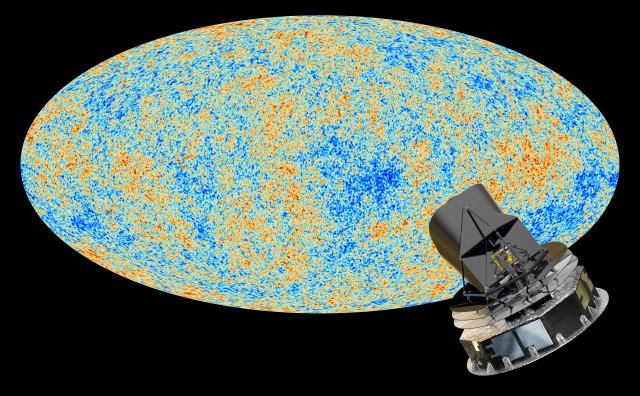
The Planck cosmic microwave background observatory and its map of temperature fluctuations on the sky. (credit: ESA)
Cosmology is a funny kind of science. At one end of the spectrum, cosmologists can explain vast swathes of the Universe with remarkable accuracy. Unfortunately, at the point where this explanation breaks down, cosmology theories don’t gently fail, allowing you to come to a safe halt on the shoulder of the inflationary-universe-highway. No, three tires blow out at once, leaving you spinning toward a high-velocity crash barrier, followed by an unsympathetic truck.
How does this happen? It comes down to the problem that quantum mechanics and gravity do not share a common theoretical framework. To describe the very earliest times of the Universe, a unified theory of quantum mechanics and gravity appears to be necessary, but there are many competing ideas for how to achieve this. Now, scientists have had a chance to digest data from the Planck mission to explore the cosmic microwave background, and some of these ideas are being tested against this new data.
Unfortunately, the test results are not as clear as we’d like them to be.
Read 13 remaining paragraphs | Comments


