
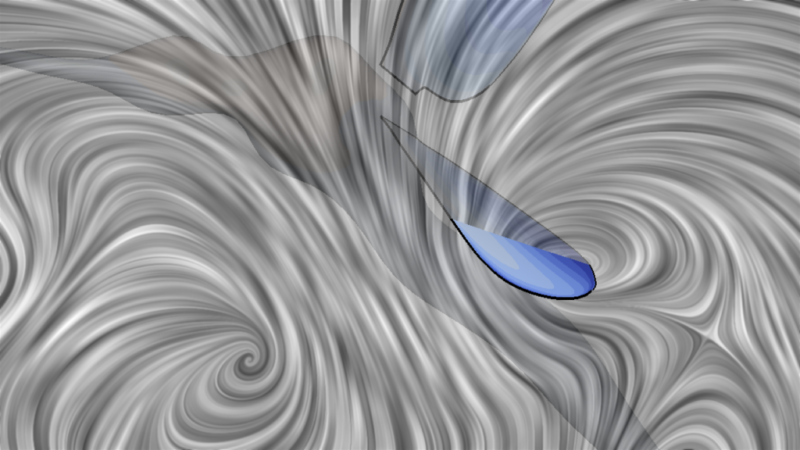
Enlarge / See that vortex on the back edge of the wing? That means lift. (credit: Bomphrey/Nakata/Phillips/Walker)
It’s unmistakable. A high-pitched whine tells you you’re sharing a room with a mosquito, and you are unlikely to end the evening without some itchy welts. The sound alone is enough to make you shudder.
You’re not imagining things. Within the insect world, mosquitoes have a distinctive flight, with a short wing stroke and a very high frequency of wing beats. And now, researchers have figured out the physics behind their flight. They have identified two mechanisms for generating lift that had not previously been seen in any animal. “Much of the aerodynamic force that supports [the mosquito’s] weight,” the authors conclude, “is generated in a manner unlike any previously described for a flying animal.”
The work, done by a small team of Japanese and UK researchers, involved setting up a series of eight high-speed cameras to capture every instant of a mosquito’s wing flap from multiple angles. The resulting data allowed them to create a digital model of the wings as they went through a full stroke. This was then used to solve fluid dynamics equations for the air around the wings, letting the researchers track the movement of the air as the wing beat through it.
Read 10 remaining paragraphs | Comments


